Armantrout-ish
i Getting to her was like shoplifting a pack of cigarettes: First there’s the thrill, the secret and theContinue Reading
i Getting to her was like shoplifting a pack of cigarettes: First there’s the thrill, the secret and theContinue Reading
I recommend all these books to the reader who is tracking poetic excellence on and off the beaten path.
Roleplay by Juliana Gray My rating: 5 of 5 stars Juliana Gray’s Roleplay is the winner of this year’s EugeneContinue Reading
It was on the occasion of his return from the Yucatan, when passing through Duty Free he saw the watch, or rather heard the whisper of the perfect prologue that slips beyond the monogrammed curtain of a discrete French cuff to deliver, sotto voce, a life-sustaining pulse to its audience as it anxiously waited for the grand drama of his life to proceed. This, he thought, was just the dramatis persona he needed.
Meaning is what an audience tries to give art when the medium itself is ineffable. Poems like T.S. Eliot’s “The Waste Land ” and John Berryman’s “The Dream Songs” are accepted today as having a discernible content and an interpretable discourse. But history tells us that the vast majority of critical readers didn’t know what to make of these poems until many years later when critical opinion eventually coalesced and pronounced their themes and method of discourse.
In no particular order of relevance are my picks for notable poetry books in 2013: Dear Boy by Emily BerryContinue Reading
Prynne achieves enviable compression of language by a heightened use of linguistic and cultural references that are strategically employed to treat themes of modern life. As his is a poetry of resistance to the new world order, it challenges the hegemony of the hardened shells of political and social structures that attempt to dominate human sentience.
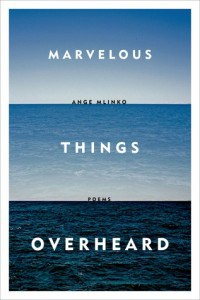
Ange Mlinko’s new book of poetry, Marvelous Things Overheard, expresses our contemporary experience by way of micronarratives, using poetry’s familiar lens of myth, fable, and anecdote, and overlaying these with the received “truth” of the arts, science and technology as they are filtered through our national experiences and family histories. The psychological perspective, one that Mlinko surely sees as uniting us with ancients, discloses an unsettling arrhythmia at the heart of our existence in the modern world.
Concluding his essay on Wallace Stevens in Poetry and the Age, Randall Jarrell commented: “A good poet is someone who manages, in a lifetime of standing out in thunderstorms, to be struck by lightning five or six times; a dozen or two dozen times and he is great.” If that is so, Seamus Heaney was a lightning rod.

Originally posted on Peony Moon:
Emily Berry is a poet, freelance writer and editor. She grew up…

 AGAINST INTERPRETATION